
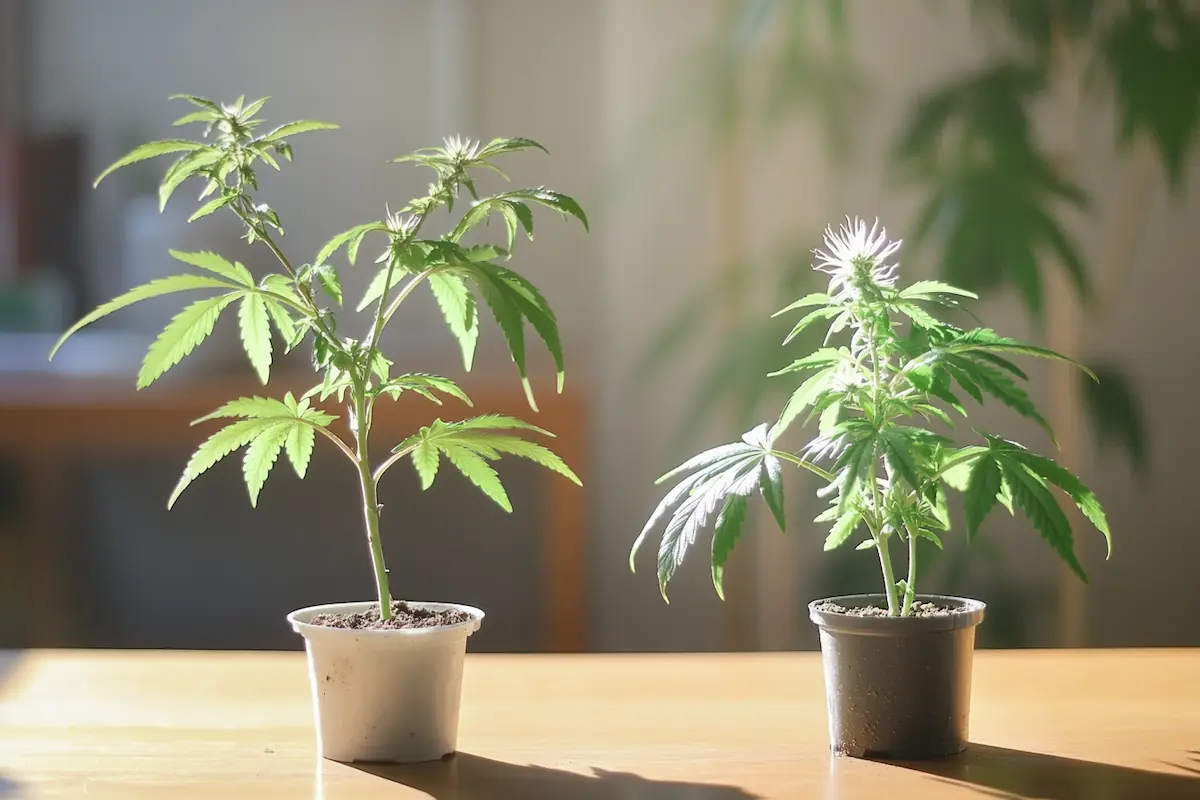
Male or female marijuana plants differ in specific characteristics that directly affect the quality of the harvest. Male plants produce pollen, while females develop the prized buds rich in cannabinoids such as THC and CBD. Therefore, correctly identifying the sex of each plant is essential to avoid unwanted pollination, which considerably lowers the value of the final product.
So how can you tell them apart? There are several visual indicators that appear in the early stages of flowering, such as the formation of pollen sacs in males and pistils in females. In addition, the overall structure and growth pattern also provide clues. These details are essential for any grower who wants to optimize production, especially in grows aiming for maximum bud potency and purity.
In short, telling male or female marijuana apart isn’t just a matter of curiosity, but of controlling the outcome of your grow. Knowing how to identify these plants in time prevents problems that affect harvest quality and lets you get products with better yield and potency. Throughout this article, we’ll explain in detail how to recognize each type of plant and how to act accordingly to protect your grow.
Why is it important to differentiate between male and female marijuana?
To get cannabinoid-rich flowers, it’s crucial to know how to tell the sexes of marijuana plants apart. Male plants don’t produce buds, but they do release pollen, which can fertilize the females. This process lowers the quality of the harvest, since pollinated buds contain seeds and have a lower concentration of THC and other cannabinoids.
Problems resulting from misidentification
Misidentifying the sex of your plants can have serious consequences for your grow:
- Reduced bud production: Males do not produce consumable flowers, which limits the harvest.
- Unwanted pollination: Males pollinate the females, producing seeded buds.
- Lower cannabinoid content: Seed formation reduces the concentration of THC, CBD and other active compounds.

Main differences between male and female marijuana
To identify whether a marijuana plant is male or female, you need to carefully observe its physical characteristics. These differences become visible during the flowering stage, when plants begin to develop their sexual structures.
1. General plant structure
The general structure of the plant is one of the first clues to distinguish between male and female marijuana.
Male plant
Male plants tend to be taller and have widely spaced branches. Their structure is less dense because their main function is to release pollen. These plants prioritize vertical growth, which makes them slimmer and more open.
Female plant
Female plants, by contrast, are more compact and develop dense branches to support their growing buds. Their sturdy shape is designed to maximize the production of flowers, which are rich in cannabinoids.
Flower and bud formation
Once the plant enters the flowering stage, the differences in flower formation between male and female marijuana become obvious.
Male plant flowers
- At the junctions of stems and branches, small sacs appear.
- These sacs contain pollen, which is released when they mature.
- They do not produce buds, which limits their value for direct consumption.
Female plant flowers
- Instead of sacs, white or yellowish pistils form, emerging from the plant’s nodes.
- These pistils are the first signs of buds, which will grow throughout the rest of the flowering cycle.
- The buds are responsible for the production of THC, CBD and other compounds.
3. Production and use
Another fundamental difference between male and female marijuana is the use that can be made of each plant.
Uses of male marijuana
Although males don’t produce buds, they can have specific uses in certain contexts:
- Fiber production: Their stems are used to make textiles and durable materials.
- Genetic crosses: Males are essential for hybridization projects, as they provide the male genetic contribution.
Uses of female marijuana
Female plants are the most valuable in marijuana cultivation, since they produce the buds used in consumable and therapeutic products. These buds contain high levels of THC, CBD and other cannabinoids that are essential for recreational and medicinal use.

How to identify the sex of marijuana in the vegetative stage
During the vegetative stage, identifying whether a marijuana plant is male or female can be a challenge, since the differences between the two sexes aren’t yet fully defined. However, some experienced growers can spot early signs by looking at certain features, such as the nodes (the points where the branches meet the stem) and the shape of the leaves.
Below, we offer a detailed guide to make the early identification of your plants’ sex easier.
Tips for early identification
1. Observe the development of knots in the first few weeks.
One of the first clues can be found in the nodes. Male plants tend to develop nodes with more widely spaced structures and small bumps on the sides, which will later form pollen sacs. Female plants, on the other hand, have a more compact structure and will eventually start to show small pistils at the nodes.
2. Use specific light to stimulate pre-flowering.
An effective technique for identifying sex earlier is to apply a specific light schedule. Reducing light exposure to 12 hours a day can induce a brief pre-flowering, allowing the plant to start showing signs of its sex before the full flowering stage.
Maintain a stable growing environment
It’s essential to ensure a stable growing environment, since factors such as stress (from sudden changes in temperature, humidity or lighting) can affect how sex is expressed. A controlled, stress-free environment ensures plants develop their natural characteristics without delays or abnormalities.
Consequences of not eliminating males on time
If male marijuana plants remain in a mixed grow alongside female plants, it’s very likely they’ll release pollen and cause unwanted pollination. This process has several negative consequences for bud production.
- Lower bud quality: Once pollinated, female plants devote their resources to forming seeds instead of boosting cannabinoid concentration.
- Reduced potency: Pollinated buds contain lower levels of THC, which affects their effectiveness.
- Poor consumption experience: Seeded buds are not only less potent, they are also unpleasant to smoke or vaporize.
That’s why it’s crucial to identify and remove male plants in time to ensure a high-quality marijuana harvest.
What to do after identifying a male plant?
Once you manage to identify a male marijuana plant, it’s important to take action based on the goals of your grow. Below, we explain the options available for dealing with these plants.
1. Immediate elimination
The most common option is to remove the males from the grow as soon as possible. This prevents pollen from being released and fertilizing the female plants, thus protecting the production of seedless buds.
2. Controlled isolation
If you want to use the male plant for genetic experiments or to create new marijuana strains, the ideal is to move it to a separate area. This way, you can collect pollen without any risk of accidental pollination in the main grow.
3. Alternative use
Although they do not produce THC-rich buds, male plants can be used for other purposes such as:
- Fiber production: The fibers from the plant's stem are useful for making textiles and ropes.
- Extraction of minor cannabinoids: Some parts of the plant contain small amounts of cannabinoids, which can be used to produce oils or tinctures.
Optimize your crop by correctly identifying the sex of marijuana
The difference between male and female marijuana is essential to ensuring a quality harvest. Spotting the characteristics of each sex in time will prevent pollination problems and maximize your yield. If you want to enjoy premium buds in Barcelona, we invite you to become a member of our cannabis club. Access the form to join here.
You may also be interested in
- Hydroponic Marijuana Cultivation: Efficient System
- Marijuana varieties
- Sex and Cannabis... a good idea?
Want to get to know us? Discover BCN Kush, our weed club in Barcelona, see how to get to the club and request your invitation. Access for members aged 18 and over only.